
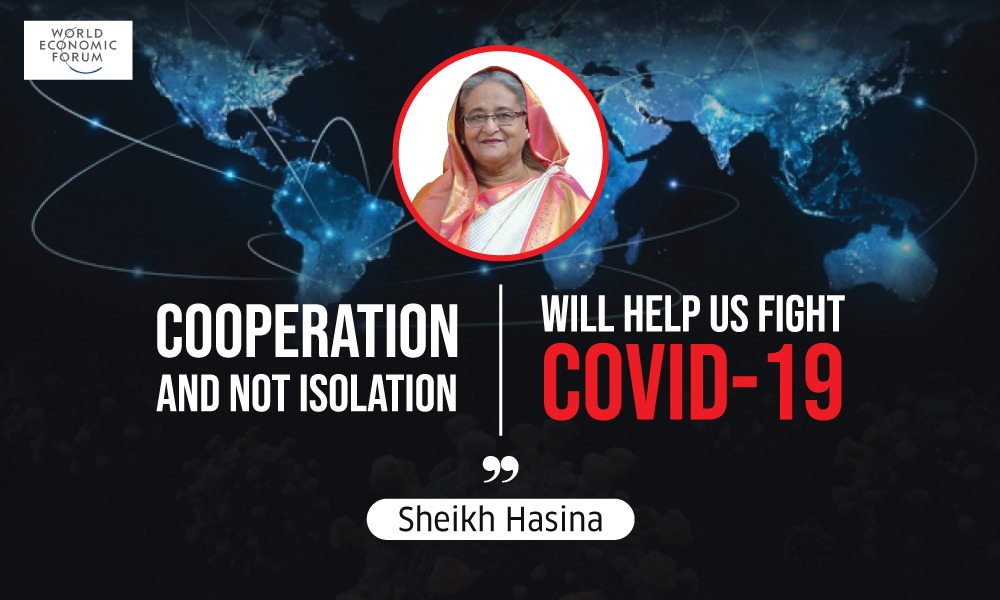
HPM Sheikh Hasina writes about her policies and plans to fight Covid-19, published on World Economic Forum's website www.weforum.org.
---
The world is facing a battle against an
unknown and invisible enemy. This enemy does not respect any border or
hierarchy and unfortunately has exposed the fragilities in our systems.
Over the last five weeks, Bangladesh,
like most countries in the world, has been fighting a dual crisis. On
the health front, we mobilized enough testing kits – gloves, masks, PPE.
Some of our entrepreneurs have even started producing these locally. We
are also in the process of making ventilators locally. Our private
sector is supporting the government by setting up thousands of hospital
beds. Our doctors, nurses, health workers, defence and law enforcement
personnel are working in the front line. With a large informal economy
and dense population, we initially wanted to shut down only affected
areas and districts. But on April 16, we went for even more stringent
measures.
This has had a telling impact on our
economy, which is also unfolding fast. In Bangladesh, we realized very
quickly that this crisis is going to cause both a demand and supply
shock for our economy. We have to sustain export industries and also
support domestic ones. I have already announced an $11.25 billion
package for various sectors of our economy, including the support
measures for different segments of the population of our society. The
primary focus of this stimulus package is domestic and export-oriented
manufacturing and services sectors, including small and medium-sized
enterprises (SMEs) and extended social safety net facilities and support
for agriculture. This support package is equivalent to 3.3% of our GDP.
Thanks to pragmatic policies and the
great efforts of our farmers, we have sufficient food, but ensuring food
security in case of a prolonged crisis will be a big challenge for all,
especially for the South Asian countries. Our agriculture sector
employs the highest number of our informal workers and it has been
adversely affected due to huge disruption of supply chains all over the
country. Around $3 billion have been allocated exclusively for
agriculture under our recently announced stimulus package. We are also
going for direct cash transfer to 10 million poor and marginal
households, which will result in supporting almost 50 million people.
As the world tackles such a complex
scenario, we will need a new kind of approach: an approach that fosters
cooperation and not isolation amongst all stakeholders. This is an
approach that we have been following in Bangladesh since 1972, when our
“Father of the Nation”, Bangabandhu Sheikh Mujibur Rahman, declared that
Bangladesh will pursue a policy of friendship towards all and malice
towards none.
In that context, I believe the following five steps will help us move in that direction.
1. We need new thinking on how to tackle inequality
Poverty and inequality within and among
societies will increase rapidly. In the last decade, we lifted half of
our poor out of poverty. Many of them will now slide back. People risk
falling into debt traps. 85% of our people work in the informal sector.
Our SMEs are badly hit. The situation is not different in other parts of
South Asia or even Africa. So, the world will need new thinking on
human wellbeing, how to tackle inequality, support the poor, and get our
economies back to pre-COVID levels.
2. We need robust global leadership from G7, G20 and OECD
A multilateral system led by the United
Nations should step forward. I must commend Professor Klaus Schwab and
the World Economic Forum for identifying “infectious diseases” as a key
risk in the Global Risks Report 2020. It highlighted rightfully the
fragilities in the health sector globally. So, the Forum’s COVID Action
Platform and the Regional Action Groups are a step in the right
direction. In addition, I also believe that in partnership with other
key institutions such as the United Nations, efforts should be taken to
chalk out a post COVID-19 exit strategy.
3. We need to devise strategies to adapt to new business norms
We are already witnessing transformation
in global business, work and manufacturing. In post-COVID times, new
norms, standards and practices will emerge. We already see that many
global brands within supply chains are not acting responsibly. This I
believe is a test for stakeholder capitalism and we therefore need to
devise strategies and pragmatic measures so that countries like
Bangladesh can adapt.
4. We need a global compact to share responsibilities
Migrant workers are frontline
contributors to societies and economies in richer countries. However,
they are suddenly finding themselves in very difficult situations,
including joblessness. That is also risking South Asian economies. So,
we need a meaningful global compact to share burdens and
responsibilities. In the Bangladesh context, we have not run away from
our responsibilities. As you may be aware, we host the largest refugee
camp in the world, and we have included the nearly 1.1 million Rohingya
refugees in our overall COVID-19 strategy.
5. 4IR technologies can help us prepare for the future
For one decade, through our innovative
A2i programme, Bangladesh is championing the digitization of our
economy. During this pandemic, we have effectively used some of the
digital tools and technologies, like Artificial Intelligence and mobile
phones to trace infections. To better prepare for the future, we can
fast develop innovative solutions, especially in health, education,
agriculture and supply chains. Utilizing Fourth Industrial Revolution
technologies will be important and one where an institution like the
World Economic Forum can take on an active role.
We are already battling climate change.
Now, a common enemy – coronavirus – is challenging our existence.
COVID-19 is an existential crisis and insular attitudes anywhere will
not work. We will need an approach of collective responsibility and
partnership from every society.
Source: weforum.org


0 Reviews:
Post Your Review